Popular Posts

Total Pageviews

Thursday, November 4, 2010

EARLY CHILDHOOD MEMORIES IN ASINGAN

BY VICTORIO COSTES


My childhood memories can go back as far as 1947..The earliest one I have ( and which I cherish ) is the one about a kiddie cart built by my brother during that year... This 4 wheeler cart is a smaller version of the two wheeler native CARITON used by farmers in their daily trek to and from the rice fields during those early days..

This was was pulled by either a carabao or a cow. But the former was preferred because the latter has a very volatile temper. It could go beserk sometimes ( like that bull which gets agitated by a red cape ). But the carabao is so mild mannered that someone coined the phrase "patient as the carabao.." Carabao translated in Ilocano is NUANG, in Pangasinan is DUWEG. Funny thing is for a while, I thought DUWEG is a pig until I was corrected by my family members who were all fluent in speaking the Pangasinan dialect.

Anyway, let us go back to my little story..

The year was 1947. It was a very good year.It was 2 years after the end of World War II. I do not know when the Americans left Asingan but I remember faintly their camp in front of our house. This busy camp was occupying the western sector of the Catholic Church yard. So I would say that I still have faint memories of 1946 which you will know shortly.

The camp was so busy that I remember these armored vehicles noisily passing in front of our house. In one instance, I crossed the road to the other side as one vehicle passed by but there were still other ones behind. My Mom saw me from the window, she called me immediately and I got whacked in the behind for doing such a foolish thing which only young kids would do.**** Years later I would see these tank armored wheel chains decorating the pathways of the Asingan Independent church going to the priest's house. I wonder if Elmer would remember these quaint relics from the war.

Let us go back to what I did in 1947

I frequently rode on that cart with some other kids. I could not remember their names anymore, but for sure some of them were my two younger sisters.I must be 4 years old then. And there were only 4 or 5 who could ride in that cart.

This Kiddie cart was built by my brother Donato, who at that time was already fond of tinkering with mechanical things.. I believe the wheels are made from 4 rubber rimmed wheels, similar to the Radio Flyer cart popular in the US. Do you know what animal he used to pull it? It was a huge male goat!

I remember we would ride it a few times especially when the weather was so nice and balmy. But we did not go very far. Just around the block.

This block consisted of: the Phil. Independent Church situated beside the Sampaga's old residence ( now the Canadido residence ), then there was the Iglesia ni Kristo church at the corner which now is occupied by the house of the Ong family. Beside this church on the way going to Urdaneta was an orchard owned my dad. That orchard was bought by Mr. Cruz and is now the site of the business building put up by Dr. Bernard Cruz, a surgeon residing in New Jersey. This block consists further of the residences of the Santiago family, then the Navarro family.

After we passed the Navarro family residence, we would turn right to enter that small street which would go straight to the municipal cemetery. But our cart did not go that far. Our cart would turn right at a small nipa house which is just parallel west to our old Spanish type house facing the Roman Catholic church. We would enter the yard of this small nipa hut following a small pathway between SILAG plants and a big Lomboy tree. Then we reach the kiskisan owned by my grandmother when she was still alive. And we find ourselves back in our house again, thus completing the very short but exciting trip. We were the only kids then who owned a kiddie cart pulled by a goat!

When that big male goat died ( maybe it was butchered ) our kiddie cart rides ceased. That goat was the only one strong enough to pull that cart with us kids on it. My brod was always the driver because he owned the goat. When the goat was gone, the cart was used for other things and we never saw it again.

My brother, who built the kiddie cart by the way, grew up to be a very good auto mechanic. Up to now, at the age of 70, he is still fixing the cars of his friends here in Toronto---#

Tuesday, July 27, 2010

FIRE AND ICE


Some say the world will end in fire,
Some say in ice.
From what I've tasted of desire
I hold with those who favor fire.
But if it had to perish twice,
I think I know enough of hate
To say that for destruction ice
Is also great
And would suffice. --Robert Frost

Monday, July 26, 2010

So Far Away! By A.B.C

Frank Sinatra - If You Are But A Dream.mp3
Found at bee mp3 search engine


As I plunged myself into the thick of the night,
To fathom its dark recesses for just a beam of light,
It was fortunate that there was little, twinkling star,
Whose rays gave light to the byway to where you are.

***
Because in my mind I knew from the very start,
That your silhouette fit the contour of my heart.
So when l gazed upon your beautiful and gentle face,
I knew then that I found you as my long, lost wish.

***
It started when I first saw you in that crowded hall,
Where your loveliness bounced against that mirrored wall,
And the radiance of your eyes penetrated my inner soul,
Which melted my yesterday’s past leaving nothing at all.

***
Happily I was holding you in a very tight embrace,
As beams of light showered my happy, smiling face.
But when I held you tight while I went on dreaming,
You left my arms empty when I woke up that morning.

***

Saturday, May 19, 2007

Beautiful Saturday in Toronto!

Miggie, Miggie, quite contrary,

How does your garden grow?

Our house a few months after we bought it in 1983...


Our house, 24 years  after. I planted those two pine trees...


The  base of the left pine tree..


The base of the right  pine tree, where most of the pretty stuff are. There is the house made from twigs, a mushroom patch mide from wood ( you cant see it very well, but believe me, its there ) plus the phlox and the hostas...


I planted this Japanese Maple  Tree about 3 years ago. Planted it on JulyFirst, the independence Day of Canada. Come to think of it, most of what I planted here are trees..


This tree stump was given away by a neighbour. He sold his house and he cut down some of the trees in his backyard. Then he brought the stumps, branches etc. into the curb for pick up by the Parks and Recreations people. We asked for the stump and he gave it willingly. He even delivered it to our  front yard because it was so heavy!


Miguelita's plants are growing very well...A few more weeks before the phlox would be full grown and the flowers will be splashing colours all over the front yard..


One side of her garden beside the pathway going to the house..Sometimes some freaking ants would build their house on the small strip of grass..but not anymore. They transfered to another part of the lawn..:)


Same spot as the last  photo but a different view..The stone foot  is my creation..flat rocks with 5 pebbles on the wide side..I call it ( surprise! ) Big Foot!...:)


Thursday, May 17, 2007

A photo essay

CARMEL-BY-THE-SEA MISSION CHURCH

In the movie "How The West Was Won" (1962), the plot is about the fifty years of Ame-rican expansion between the 1830s and 1880s as viewed through the experiences of two families as they migrate by the Erie Canal, continue over the prairies during the California gold rush, suffer through the civil war, and finally help build the railroads on the plains and bring law and justice to the frontier.

But the texture of the film was spiced to Hollywood flavor which was primarily intended to entertain the movie-going public more than anything else.. It said nothing about the role of Mission Churches in converting the native people to the Faith and helped bring ‘law and justice to the frontier.’

One such Mission Church is Carmel-by-the-Sea. Originally called Mission San Carlos Borro-meo del Rio Carmelo, it was founded on June 3, 1770 on the shores of Monterey Bay. One year later on Aug. 24, the mission was relocated to a site at the mouth of the River of Carmel where more abundant fresh water could be obtained.

The following pictures which were taken just recently show how the Mission looks like today:

A view of the front gate leading to the Church.


A front view of the Church at a time when a wedding was going on as two ladies in bright red were about to enter. It’s a practice of the Church to shut its door to all others except to participants and guests of the wedding ceremony.


Religious statues on display at the Church’s museum

An old camera and other artifacts on display at the museum.


A view from its quadrangle showing a cross and the Church’s spire.


A marker at the foot of the cross says it all.


A marker in the Church grounds "Honoring Four Early Americans in California."

~~~~~~~~~~~~~~~~~~~~~~~~~~~~~~~~~~~~~~~~~~~~~~~

ADDED MATERIAL

Carmel-by-the-Sea and its famous Ex-Mayor

Carmel-by-the-Sea. It's like a village out of a children's story book, a seaside town of quaint cottages nestled under gnarled but protective live oak trees. You'd almost expect Hobbitts or elves to inhabit the place. The residents here are real humans, though - some famous and some not. Undisputedly, this charming town's most famous resident is actor, director and former mayor Clint Eastwood.

Why is Clint Eastwood so partial to the Carmel area? Probably for the same reasons the rest of us like it: crashing waves and sea otters playing at Point Lobos, incomparable ocean views hidden around every corner and relaxed ambience to calm the most frenetic of souls.

Eastwood is a native Californian who discovered the Carmel area when he was stationed a few miles north at Fort Ord during the Korean War. After leaving the military, his friends Martin Milner of Route 66 and David Janssen of The Fugitive persuaded him to try acting and the rest is movie-making history. Eastwood spent his early movie-making years in Los Angeles, but he eventually returned to the Carmel area where he still lives.

Eastwood demonstrates his love for the Carmel area in his professional life. He owns a hotel and restaurant, and a golf course. He named his production company, Malpaso Productions, for a creek just south of town. He even directed his first movie here in 1971: Play Misty for Me, the story of a late-night jazz deejay who is terrorized by an obsessive ex-lover. The movie was set in Carmel and Monterey and features many local sights, including nearby Point Lobos and downtown Carmel.

As if all this weren't enough, in 1986 Eastwood wanted to build a small building in downtown Carmel. His efforts were stymied by the town's bureaucratic government and he decided to do something about it. He ran for mayor, winning with 72% of the vote. During his two-year tenure, he successfully made it easier to build or remodel property, got a tourist parking lot built, rescued the historic Mission Ranch from developers and opened a children's annex to the city library.

There are a number of things Eastwood to see and do in the Carmel area:

  • Visit the Mission Ranch for a meal or stay there overnight. Their Sunday brunch is especially pleasant on a sunny day.

  • Visit Pebble Beach (he's part owner).

  • Visit the Hog's Breath Inn at San Carlos and Fifth Avenue in downtown Carmel. Eastwood and his partners sold it a few years ago, but it's the place people refer to as "Clint Eastwood's restaurant."

  • Spend some time at Point Lobos, just south of town. It's a featured location in Play Misty for Me.

A source said Clint's salary as a Mayor was about 200$ a month...

################################################


Wednesday, May 16, 2007

comments...
 
on the Yosemite Park photo essay..
 
what a picturesque site, I could almost taste the fresh air...
Comment from britishempress - 15/05/07 8:56 AM"
 
Good to know about that: tasting 'fresh air' at AJ than tasting 'blood' at DC. -SS
 

The blood letting is already history..I hope...--Vic

 
I love the beautiful pictures. Being there in person must be awesome. The pictures match the lines of the hymn..--Rain
 
on the Flowering Fortune Tree
 
As much as I would like to believe in the myth I cannot.  Our so called fortune plants in the office bear its flowers every year.
Comment from
BritishEmpress -
 
Hmmm..your so called fortune plants in your office must be a different variety.. Our fortune plant at home also bear flowers every 5 years, I think..Fortune plants in Asingan could reach as high as 10-12 feet. These are planted on the ground and they multiply with the years.
 
A local name for the same plant is BASTON NI SAN PEDRO( St. Peter's Rod ) According to a biblical legend, St. Peter was walking away from Rome with that rod. Then he met a figure and he asked him in wonder: WHERE ARE YOU GOING, LORD? or Quo vadis Domine?
 
The figure answered, "I am going back to Rome, to be crucified again."
 
St. Peter, in shame, left his Rod stuck to the ground, abd he walked back to Rome. According to legend, he was crucified upside down.
 
Meanwhile, the Rod that he left on the ground sprouted leaves and flowers and to this day, it is known as the Fortune plant--Vic


by Archie Macanas


Fortune tree bloomed on Mother's Day...

Rumors say that this plant seldom  blooms. Actually, it’s my first time to see one.  My wife said its her second time. Many of our guests were surprised and then came the talk about mythical or supernatural beings connected to it.  Sometimes this is only the way to start our non-stop conversation.
 
It reminds me of the scent of dama de noche or Sampaguita in front of the Edrada "La Sampaguita" residence that commenced  shortly before or after dusk, the aroma spreading throughout the whole neighborhood.. The same case with our fortune plant.  My wife ( my model in the above photo ) don’t want to bring it out. She wanted it inside the house so the luck will stay. I don’t know if that’s true, but anyway   luck comes to whoever  believes in  it
 
A flowers for mothers day? That flower of fortune plant is enough so I did not spend any for flowers for my wife. But my two kids surprised her when we arrived home after I visited my mom "round trip" from San Diego. They prepared things to surprise us especially their mom. There was   cake, wine,  balloons and flowers by my son ( from his own expenses as a  part time waiter ) while he is in college. I told my wife that this is her first time to have a conventional mother’s day. She waited until our son turned 18.
My son Beian edited a video for his mom receiving a surprise gift from the mother’s day and published into "my space.com" website.
Just in case if the link doesn’t work by clicking just follow the instruction. Please highlight the address below then click the right button of your mouse then click copy, afterward go to your browser address then click your mouse until the cursor appear then click left button then click paste then click the go button or enter. "Voila!"
 
 
After viewing you can click more videos to be viewed ( like the "milk and cereal" )  a very funny video.


Tuesday, May 15, 2007

A PHOTO ESSAY FROM SS

When through the woods, and forest glades I wander,
And hear the birds sing sweetly in the trees.
When I look down, from lofty mountain grandeur
And see the brook, and feel the gentle breeze.

Then sings my soul, My Saviour God, to Thee,
How great Thou art, How great Thou art.
Then sings my soul, My Saviour God, to Thee,
How great Thou art, How great Thou art!

2nd stanza, HOW GREAT THOU ART

************

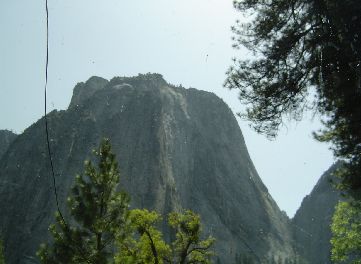
YOSEMITE: WHERE MOTHER NATURE AS AN ARTIST IS AT HER BEST

Nowhere else on earth has Nature assembled its most and greatest works of art than in the Yosemite Valley. Its canvass and stones are the Sierra Nevada region and mountain of central California; its pigments and polish are the four seasons and glaciers (which produced the shiny flat surface of some rocks); its brush and scalpel are the water, wind, sand and other small abrasives; its fingers are the Pacific plate slide and gravity; and its patrons are the eons of time which extends as far back as 500 million years ago and the people who come to feast in its beauty. It has even adorned the surroundings of its exhibition gallery with proud (branches arcing upwards), majestic (towering like king), and long-life (perhaps centuries old) redwood trees.

The pictures that follow were taken yesterday which is a day in summertime. Giving a caption to each one of them is unnecessary and is almost desecrating; hence, enjoy.

.... ss


Sunday, May 13, 2007

Dear Manong Vic,
 
This article was passed on to me in jest by my British boss about 18 mos back. As it turned out, it has been circulating in the net for years and maybe you have read it. Still, i find it real funny and amusing and wanted to share it with you, just in case you have missed it. It was written by a British news correspondent assigned to the Philippines. Riotously funny and, at times, embarrassingly true, this piece depicts us in the eye of a foreign observer and offers glimpses and side glances of our unique culture.


Matter of Taste

By Matthew Sutherland


I have now been in this country for over six years, and consider myself in most respects well assimilated. However, there is one key step on the road to full assimilation, which I have yet to take, and that's to eat BALUT.


The day any of you sees me eating balut, please call immigration and ask them to issue me a Filipino passport. Because at that point there will be no turning back. BALUT, for those still blissfully ignorant non-Pinoys out there, is a fertilized duck egg. It is commonly sold with salt in a piece of newspaper, much like English fish and chips, by street vendors usually after dark,  presumably so you can't see how gross it is. It's meant to be an aphrodisiac, although I can't imagine anything more likely to dispel sexual desire than crunching on a partially formed baby duck swimming in noxious fluid. The embryo in the egg comes in varying stages of development, but basically it is not considered macho to eat one without fully discernible feathers, beak, and claws. Some say these crunchy bits are the best. Others prefer just to drink the so-called 'soup', the vile, pungent liquid that surrounds the aforementioned feathery fetus...excuse me; I have to go and throw up now. I'll be back in a minute.


Food dominates the life of the Filipino. People here just love to eat. They eat at least eight times a day. These eight official meals are called, in order: breakfast, snacks, lunch, merienda, merienda-ceyna, dinner, bedtime snacks and no-one-saw-me-take-that-cookie-from-the-fridge-so-it-doesn't-count. The short gaps in between these mealtimes are spent eating Sky Flakes from the open packet that sits on every desktop. You're never far from food in the Philippines. If you doubt this, next time you're driving home from work, try this game. See how long you can drive without seeing food and I don't mean a distant restaurant, or a picture of food. I mean a man on the sidewalk frying fish balls, or a man walking through the traffic selling nuts or candy. I bet it's less than one minute.


Here are some other things I've noticed about food in the Philippines.


Firstly, a meal is not a meal without rice - even breakfast. In the UK, I could go a whole year without eating rice.  Second, it's impossible to drink without eating. A bottle of San Miguel just isn't the same without gambas or beef tapa. Third, no one ventures more than two paces from their house without baon (food in small container) and a container of something cold to drink. You might as well ask a Filipino to leave home without his pants on.  And lastly, where I come from, you eat with a knife and fork. Here, you eat with a spoon and fork. You try eating rice swimming in fish sauce with a knife. One really nice thing about Filipino food culture is that people always ask you to SHARE their food. In my office, if you catch anyone attacking their baon, they will always go, "Sir! KAIN TAYO!" ("Let's eat!"). This confused me, until I realized that they didn't actually expect me to sit down and start munching on their boneless bangus. In fact, the polite response is something like, "No thanks, I just ate." But the principle is sound - if you have food on your plate, you are expected to share it, however hungry you are, with those who may be even hungrier. I think that's great. In fact, this is frequently even taken one step further. Many Filipinos use "Have you eaten yet?" ("KUMAIN KA NA?") as a general greeting, irrespective of time of day or location.


Some foreigners think Filipino food is fairly dull compared to other Asian cuisines. Actually lots of it is very good: Spicy dishes like Bicol Express (strange, a dish named after a train); anything cooked withcoconut milk; anything KINILAW; andanything ADOBO. And it's hard to beat the sheer wanton, cholesterolic frenzy of a good old-fashioned LECHON de leche (roast pig) feast. Dig a pit, light a fire, add 50 pounds of animal fat on a stick, and cook until crisp. Mmm, mmm... you can actually feel your arteries constricting with each successive mouthful. I also share one key Pinoy trait ---a sweet tooth.  I am thus the only foreigner I know who does not complain about sweet bread, sweet burgers, sweet spaghetti, sweet banana ketchup, and so on. I am a man who likes to put jam on his pizza. Try it! It's the weird food you want to avoid. In addition to duck fetus in the half-shell, items to avoid in the Philippines include pig's blood soup (DINUGUAN); bull's testicle soup, the strangely-named "SOUP NUMBER FIVE" (I dread to think what numbers one through four are); and the ubiquitous, stinky shrimp paste, BAGOONG, and it's equally stinky sister, PATIS.


Filipinos are so addicted to these latter items that they will even risk arrest or deportation trying to smuggle them into countries like Australia and the USA, which wisely ban the importation of items you can smell from more than 100 paces. Then there's the small matter of the purple ice cream. I have never been able to get my brain around eating purple food; the ubiquitous UBE leaves me cold.


And lastly on the subject of weird food, beware: that KALDERETANG KAMBING (goat) could well be KALDERETANG ASO (dog)... The Filipino, of course, has a well-developed sense of food.  Here's a typical Pinoy food joke: "I'm on a seafood diet. "What's a seafood diet?" "When I see food, I eat it!"


Filipinos also eat strange bits of animals --- the feet, the head, the guts, etc., usually barbecued on a stick. These have been given witty names, like "ADIDAS" (chicken's feet); "KURBATA" (either just chicken's neck, or "neck and thigh" as in "neck-tie"); "WALKMAN" (pigs ears); "PAL" (chicken wings); "HELMET" (chicken head); "IUD" (chicken intestines), and BETAMAX" (video-cassette-like blocks of animal blood).Yum, yum. Bon appetit.  "A good name is rather to be chosen than great riches"-- (Proverbs 22:1)


WHEN I arrived in the Philippines from the UK six years ago, one of the first cultural differences to strike me was names. The subject has provided a continuing source of amazement and amusement ever since. The first unusual thing, from an English perspective, is that everyone here has a nickname. In the staid and boring United Kingdom, we have nicknames in kindergarten, but when we move into adulthood we tend, I am glad to say, to lose them.


The second thing that struck me is that Philippine names for both girls and boys tend to be what we in the UK would regard as overbearingly cutesy for anyone over about five. Fifty-five-year-olds colleague put it.  Where I come from, a boy with a nickname like Boy Blue or Honey Boy would be beaten to death at school by pre-adolescent bullies, and never make it to adulthood. So, probably, would girls with names like Babes, Lovely, Precious, Peachy or Apples. Yuk, ech ech.


Here, however, no one bats an eyelid. Then I noticed how many people have what I have come to call "door-bell names". These are nicknames that sound like -well, doorbells. There are millions of them. Bing, Bong, Ding, and Dong are some of the more common. They can be, and frequently are, used in even more door-bell-like combinations such as Bing-Bong, Ding-Dong, Ting-Ting, and so on.  Even our newly appointed chief of police has a doorbell name Ping. None of these doorbell names exist where I come from, and hence sound unusually amusing to my untutored foreign ear.


Someone once told me that one of the Bings, when asked why he was called Bing, replied, "because my brother is called Bong". Faultless logic. Dong, of course, is a particularly funny one for me, as where I come from "dong" is a slang word for well; perhaps "talong" is the best Tagalog equivalent.


Repeating names was another novelty to me, having never before encountered people with names like Len-Len, Let-Let, Mai-Mai, or Ning-Ning. The secretary I inherited on my arrival had an unusual one:Leck-Leck. Such names are then frequently further refined by using the "squared" symbol, as in Len2 or Mai2. This had me very confused for a while.


Then there is the trend for parents to stick to a theme when naming their children. This can be as simple as making them all begin with the same letter, as in Jun, Jimmy, Janice, and Joy. More imaginative parents shoot for more sophisticated forms of assonance or rhyme, as in Biboy, Boboy, Buboy, Baboy (notice the names get worse the more kids there are-best to be born early or you could end up being a Baboy). Even better, parents can create whole families of, say, desserts (Apple Pie, Cherry Pie, Honey Pie) or flowers (Rose, Daffodil, Tulip). The main advantage of such combinations is that they look great painted across your trunk if you're a cab driver. That's another thing I'd never seen before coming to Manila -- taxis with the driver's kids' names on the trunk. Another whole eye-opening field for the foreign visitor is the phenomenon of the  "composite" name. This includes names like Jejomar (for Jesus, Joseph and Mary), and the remarkable Luzviminda (for Luzon, Visayas and Mindanao, believe it or not). That's a bit like me being called something like  "Engscowani" (for England, Scotland, Wales and Northern Ireland). Between you and me, I'm glad I'm not. And how could I forget to mention the fabulous concept of the randomly inserted letter 'h'. Quite what this device is supposed to achieve, I have not yet figured out, but I think it is designed to give a touch of class to an otherwise only averagely weird name. It results in creations like Jhun, Lhenn, Ghemma, and Jhimmy. Or how about Jhun-Jhun (Jhun2)?


How boring to come from a country like the UK full of people with names like John Smith. How wonderful to come from a country where imagination and exoticism rule the world of names. Even the towns here have weird names; my favorite is the unbelievably named town of Sexmoan (ironically close to Olongapo and Angeles). Where else in the world could that really be true?  Where else in the world could the head of the Church really be called Cardinal Sin?  Where else but the Philippines! Note: Philippines has a senator named Joker, and it is his legal name.


NDE's Grandchildren...

My jewels- AJ(6 years old), Maiya (almost 4) and Grayson,the baby (2 weeks old then, now almost 4 months).

They're adorable! God bless them.

NDE

########################

Hello,
 
Please check the link below.  This article that Dave wrote is old but just recently posted in the pangasinan website by Manong Vic Costes.  Enjoy.
 
Cheers,
Marcie


From: aemem
Town_City:
Email:
To: Vic
Remote Name: pool-71-116-130-164.lsanca.dsl-w.verizon.net
Date: Saturday, May 12, 2007
Message
I know this page is more like a chit chat forum but to come across here an article like "Rediscovering the Philippines" by David Wise is indeed a very pleasant relief! It makes for good reading and kinda makes your day!


COMMENTS

COMMENTS, HERE AND THERE

I cringed with envy at the very organized backyard you showed us. I remember your deck on our last visit including the halo-halo and sumptuous dinner you served us. Oh, the price of retirement! But it’s not still in the horizon for me although I received the state’s longevity award recently.

****

That visit was quite a while ago, I hope you would come again...The deck was a dinky one then, now we made it big so we can relax and I can enjoy my retirement! Mia, as shown by these photos taken yesterday is already a teen ager..She is shown here while singing a few songs while we were in the deck.  You, as a grandparent must know the feeling when your grandchild is showing a special kind of talent ( which you believe she picked up from you..:)  ).


Who responded to my comment about QM2? I think good feedback should be disseminated. I’m proud of those kababayan at QM2 and on the Norwegian Dawn where we cruised to the Bahamas last year. NDE

****

His screen name is SS, a gentleman and a scholar. He also writes as a hobby and he has recently arrived from the Philippines. He is from Pangasinan and so far, he has contributed a number of good stories and photos in the Asingan Journal. You should check his entries ( as well as the other articles ) that appeared in the AJ.

***

Saturday, May 12, 2007

MAPUA INSTITUTE OF TECHNOLOGY REVISITED

A photo essay

MAPUA IS IN THE HEART FOREVER

Although I wasn’t able to practice my profession, I have always remained loyal to the school that gave it to me: Mapua Institute of Technology (MIT). Four dramatic events mark my tenure at MIT: 1) rebelliousness of Metro-Manila’s student population against the establishment, 2) a raucous NCAA basketball season, 3) a bungled, and almost tragic, field trip to Ambuklao Dam, and 4) a failed graduation photo session.

A few months before Martial Law was clamped down in the country (September, 1972), MIT students joined a peaceful march to Gate 7 of Malacanang palace where a fiery, diminutive PCC (now TUP) student leader chided ‘Apo’ Marcos about his 27 war medals. When Martial rule came, street demonstrations were banned, some militant student lead-ers went underground, a number of personalities confined at Camp Crame were made to pick up the litters on the ground, students with long hairs picked up by Metrocom agents and given a free short haircut, etc.

Their mouths literally muzzled by the authorities, students of NCAA-member schools turned their energies to the basketball games played during the season. The big names on MIT’s Cardinals bench then were Atoy Co and Trajano, DLSU’s Lim Em Beng and Mike Bilbao, the Cesar brothers of JRC (now JRU) and SSC’s Otazu. In one match pitting MIT against another school, the rooting and boos were so maddening as, e.g., "xxx (name of player who made a basket) mukhang aso" repeatedly shouted in increasing crescendo. More often than not, as the doors of Rizal Memorial Stadium were opened to disgorge the spectators inside, fist-fights would ensue with some losers chasing the victors all the way to inside the commuter buses to bash them.

The following photos were taken last April with the permission of the Admissions Director.

A view of the North or "N" building where classes in EE major subjects and Laboratories were being held.


A view of the Middle or "M" building with the bust of Don Tomas Mapua in the foreground.

A closer view of Don Tomas Mapua’s bust.


A lay-out of MIT’s Intramuros campus as it stands today.


MIT derives it name from its founder, Don Tomas Mapua, an architecture graduate of Cornell University. It was fully owned by the Mapua family until 1999 when it was acquired 100% by the Yuchengco Group of Companies (YGC). Under YGC, MIT has expanded to include other schools like Information Technology (IT); Earth and Material Science and Engineering (EMSE); Graduate Studies (GS); Industrial Engineering and Engineering Management (IE); Health Sciences; Languages, Humanities and Social Sciences. It now has a campus in Makati City where the IT and Health Sciences schools are situated.

The High School and General Engineering Departments were used to be housed at the Doroteo Jose building, Sta. Cruz, Manila, until their transfer to the present Intramuros campus. There was a time (Black Friday) in 1968 when classes at DJ were suspended because of massive rescue operation (involving 6,000 volunteers mostly Mapuans) being carried out at the site of Ruby Tower (Doroteo Jose and Teodora Alonzo streets) which collapsed during an Intensity 7 earthquake on Aug. 2, 1968. 342 of the building’s more than 600 tenants perished in the calamity with 270 badly injured survivors freed from the debris after more than a week of rescue operation.

The MIT chapel located between the North or "N" building and Muralla St.


This is what stands today directly behind the MIT chapel. What used to be the "Lyceum of the Philippines" is now a university.

A view of Manila City Hall’s "Big Ben" from Parian Wall fronting MIT’s Main Gate. Owing to its proximity, it offers an alternative means of keeping track of the time to Mapuans doing ‘out of campus’ problem-solving projects in their Surveying subject.


Something very tragic nearly happened during our Batch’s field trip to Ambuklao Dam in Baguio shortly before our graduation (May 1973) --- had it happened, you wouldn’t be reading this blog article right now.

Working through his wife, the EE Dean eventually mellowed down to allow us to make the Ambuklao Dam trip. On the morning of a night stay at Baguio’s Ambassador Hotel, the ordered Binalonan minibuses arrived and on seeing them, a number of us felt wary about the mechanical integrity of some of them. Nonetheless, we subdued in our minds whatever wariness we had and took our pick of which minibus to ride on.

A few miles from the outskirts of the city, our minibus started to sputter and lag behind the others. After several of those sputters we decided we could take no more and sort of ‘twisted the arm’ of the driver to bring us to the last gasoline station we passed by where we contracted another vehicle.

At km 17 of the 35-km Ambuklao road, there was a 90-degree bend to the right. On our right was an 800-m tall mountain and on the left was an equally deep ravine. A few minutes before the turn, we smelled burnt brake lining followed by a shrill cry from the driver indicating that the brake was not functioning. Luckily, he had the presence of mind to bump the vehicle to the mountainside rather than let it go to plunge into the ravine.

To us in that vehicle, we returned to Manila the following evening traumatized as we left behind one class member at the Baguio General Hospital with a broken jaw and wrist.

To members of MIT EE ’73, don’t show me a copy of our graduation picture; I was not in it. I missed the picture-taking by a few minutes because of a monstrous traffic jam on my way from Malabon toIntramuros.

----SUBMITTED BY SS